In this article
What to know
- The 2006 paper provides direct adult sermorelin cognitive evidence.
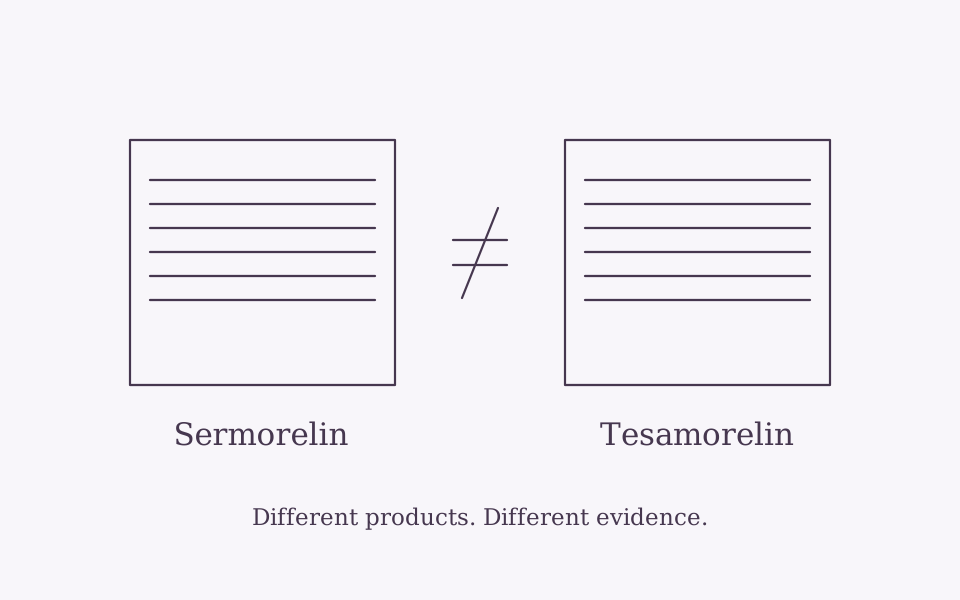
- The 2012 cognitive trial used tesamorelin, a different analogue.
- Later tesamorelin studies do not establish a consistent cognitive benefit.
There is evidence, but the promise needs narrowing
Adult GHRH research includes positive cognitive findings, including a six-month study using sermorelin. It would be inaccurate to say the subject has never been tested in people. It would also be inaccurate to promise that a current sermorelin service prevents dementia or reliably improves memory. The studies differ in drug, population and outcome, and newer tesamorelin trials have not supplied a consistent cognitive benefit. [1] [2] [3] [4]
The relevant decision is whether the proposed clinical purpose justifies an ongoing service. A hormone increase cannot answer that question by itself. Nor can a general reference to the GHRH pathway substitute for identifying the actual intervention.
The direct sermorelin finding deserves credit
Vitiello and colleagues examined six months of daily GHRH treatment or placebo in 89 healthy older adults. The paper identifies sermorelin acetate and reports better performance on selected tests involving problem solving, processing speed and related cognitive tasks. This provides direct adult sermorelin evidence, rather than a conclusion borrowed entirely from another analogue. [1]
The boundary is equally consequential. Healthy older participants completing research tests are not the same population as patients with established dementia. Better scores on selected tasks do not demonstrate prevention of Alzheimer disease, preservation of independence over years or benefit from every compounded formulation offered today.
The companion analysis is What adult sermorelin studies establish.
The larger 2012 study used tesamorelin
Baker and colleagues enrolled 152 adults with normal cognition or mild cognitive impairment in a randomized trial of tesamorelin or placebo for twenty weeks. The study reported a favorable overall cognitive effect, particularly involving executive function. Tesamorelin is a distinct stabilized GHRH analogue. Its results are relevant to the pathway, but are not a trial of a modern sermorelin vial or sublingual preparation. [2]
Executive function is also more specific than the phrase better memory. A clear service explanation should name the measured domain, rather than expanding a favorable composite score into a promise covering concentration, recall and every other cognitive complaint.
Later trials make the picture less tidy
A 2025 randomized, open-label trial studied tesamorelin in 73 people with HIV, abdominal obesity and neurocognitive impairment. The between-group cognitive difference was not significant, even though waist circumference improved. Its limited power and absence of a placebo arm matter, but a within-group trend cannot be presented as proof of superiority over the comparison group. [3]
A separate 2026 double-blind pilot studied 22 participants ranging from normal cognition to mild cognitive impairment over ten weeks. Tesamorelin was not directly associated with significant changes in the study measures. Exploratory machine-learning findings about brain regions are hypotheses for further work, not a demonstrated cognitive treatment effect. [4]
Biology and daily function need separate evidence
It is reasonable to investigate whether changing the GH–IGF-1 pathway influences brain function. It is not reasonable to assume that a higher IGF-1 result means a person will remember appointments or remain independent longer. Those are different endpoints, and the latter require an appropriate design and enough follow-up to observe meaningful change.
A clinic can make this distinction practical by specifying the concern being addressed and the assessment that would count as worthwhile progress. Without that explanation, a laboratory response can become the only visible definition of success. Continued prescribing then risks becoming a commitment without a clearly stated clinical goal.
The route and care model still change the offer
The cited cognitive studies do not establish equivalence between injected research preparations and commercial sublingual tablets or troches. A simpler routine may be attractive, but its convenience cannot bridge an evidence gap. Evaluate the formulation and care agreement together, while keeping their strengths distinct.
For an ongoing service, establish how the initial evaluation, medication, follow-up and testing are charged. Confirm who reviews concerns between appointments and what happens if the treatment is stopped. A commitment justified by an uncertain cognitive goal should not become harder to exit because its renewal conditions were never made clear.
A proportionate next step
Memory changes deserve an assessment of the actual symptoms and their possible causes. Bring the specific claim and the proposed preparation to that discussion. The useful question is whether the published evidence applies closely enough to justify the treatment burden, not whether the mechanism sounds plausible or an author has used an optimistic title.
Our comparison of Hone and Maximus helps make the service commitments visible; the research should determine how much confidence to place in the proposed outcome. The direct adult sermorelin findings earn a fair hearing. They do not supply a guarantee of memory improvement, and they should not be stretched into a dementia-prevention promise.
For service details and tradeoffs, read Compare Hone and Maximus.
Sources
- Vitiello et al. (2006): six-month sermorelin cognition study (opens in a new tab)
- Baker et al. (2012): randomized tesamorelin cognition trial (opens in a new tab)
- Ellis et al. (2025): tesamorelin and neurocognitive impairment in people with HIV (opens in a new tab)
- Stewart et al. (2026): tesamorelin cognition and brain connectivity pilot (opens in a new tab)
Research describes groups and specific study conditions. Your medical history, symptoms and treatment decisions require advice from your own qualified clinician.